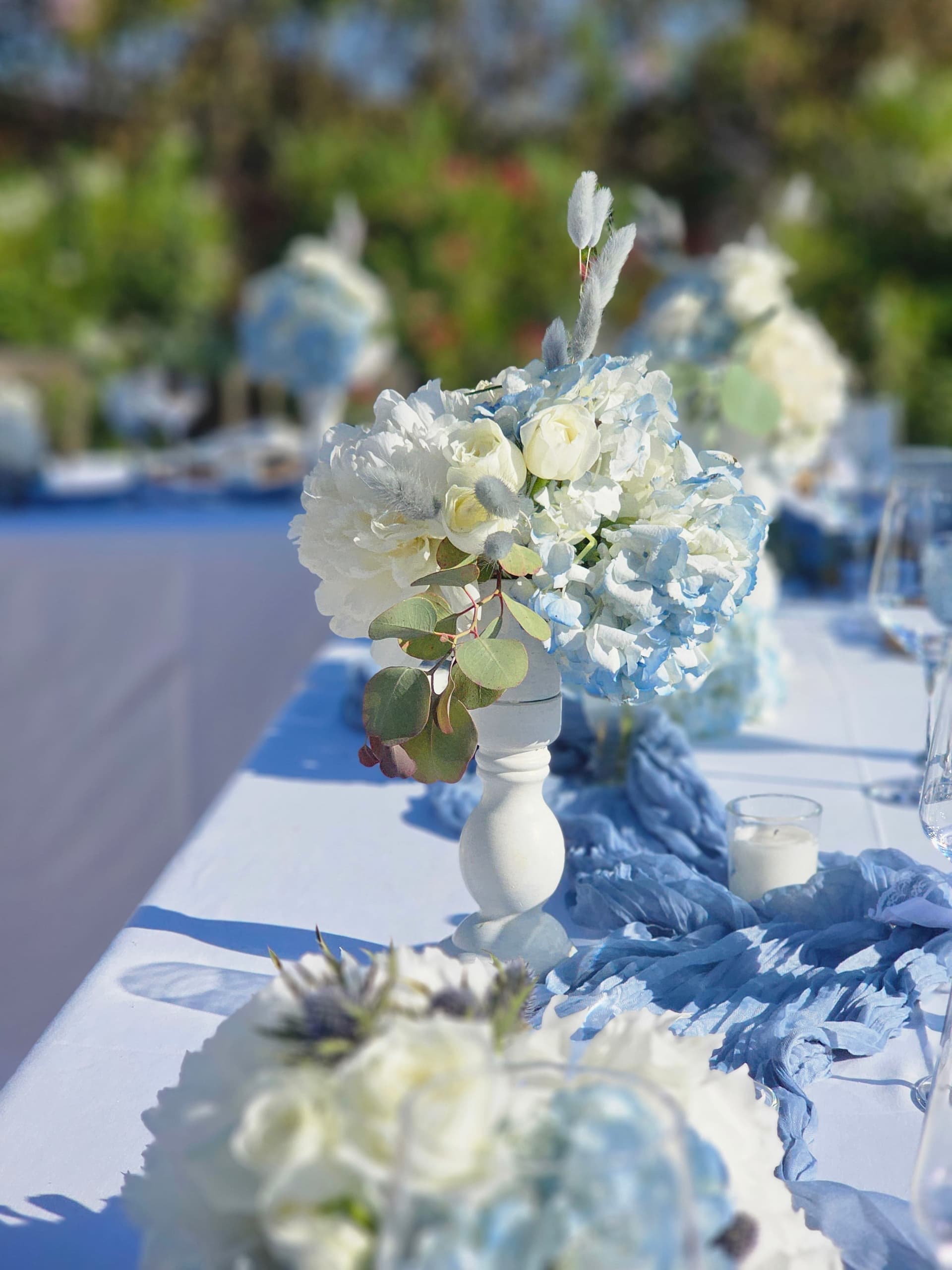
Sustainable Wedding Floristry: Luxury Meets Sustainability
Imagine this: you stand barefoot on a Mallorcan finca, the evening sun bathes everything in warm gold, and the wind carries the scent of wild lavender and freshly cut rosemary toward you. The wedding flowers on your table come from the garden next door – no flight route, no refrigerated truck, no plastic. And yet – or precisely because of this – they are breathtakingly beautiful.
In our work as wedding florists, we are seeing it more and more often: couples who want a sustainable wedding without compromising on aesthetics. And we'll tell you honestly – they don't have to. Sustainable wedding floristry is not a compromise. It is the actual luxury experience. Fresh seasonal flowers, hand-tied with kenzan instead of floral foam, curated by a florist who chooses every blossom with care – that's sustainable floristry as we understand it. Whether a classic wildflower bouquet or a structured arrangement with Mediterranean plants from the finca next door – a sustainable wedding is always also an authentic wedding.
In this guide, we'll show you what sustainable wedding floristry really means, which seasonal flowers bloom most beautifully in which month, why you should avoid floral foam, and how your wedding flowers can even live on beyond the big day. Let yourself be inspired.
What does sustainable wedding floristry really mean?
Sustainable wedding floristry means: using local and seasonal flowers, avoiding floral foam, working with natural materials, and creating a cycle for the flowers after the celebration. The result isn't less – it's more aesthetic.
Sounds simple? At its core, it is. An ecological wedding doesn't begin with grand gestures, but with conscious decisions. Where do the flowers come from? Which materials hold them in shape? And what happens to all the arrangements after the last dance? Whether you are planning minimalist or opulent sustainable wedding decor – the same principles always apply.
In our daily work as wedding florists, we have learned that sustainable floristry and luxury don't just coexist – they depend on each other. A peony coming straight from a regional field in May has a more intense fragrance, lasts longer, and radiates more vibrantly than any imported variety. An arrangement with moss and kenzan instead of plastic floral foam doesn't just look more natural – it also feels more honest.
What a green wedding does NOT mean: presenting artificial flowers as a sustainable alternative. Artificial flowers are made of polyester, PVC, or plastic, are not biodegradable, and produce significant emissions during manufacturing. They may seem like a clever solution at first glance, but real sustainability looks different. We call this greenwashing – and it has no place in wedding decoration.
An eco-friendly wedding is a celebration that consciously works with natural resources: from choosing seasonal and local flowers, to avoiding harmful materials like conventional floral foam, all the way to passing on the arrangements after the celebration. It's a wedding that's not only a good day for the couple, but also for nature.
Seasonal Wedding Flowers – the most beautiful calendar of the year
Seasonal flowers are the heart of every sustainable wedding. They bloom exactly when nature intended – and that's precisely what makes them so incomparably alive. No forced growth in greenhouses, no energy-intensive flights from Kenya or Ecuador. Instead: maximum freshness, the most intense fragrance, and a vibrancy of color that only true seasonal flowers possess. Local flowers for your wedding from regional growers – that's the heart of sustainable floristry.
If you want to know which flowers will bloom most beautifully in your wedding month, we have put together our seasonal calendar for you – for Germany and Mallorca.
Seasonal Calendar: Wedding Flowers Month by Month
| Month | Germany | Mallorca |
|---|---|---|
| January – February | Tulip, Hyacinth, Anemone | Almond Blossom, Mimosa |
| March – April | Ranunculus, Early Peony, Cherry Blossom | Orange Blossom, Wild Rosemary |
| May – June | Peony (Peak), Lilac, Lily of the Valley | Lavender, Bougainvillea |
| July – August | Rose (local), Lavender, Cosmos | Oleander, Citrus Blossoms |
| September – October | Dahlia, Sunflower, Autumn Cosmos | Autumn Lavender, Fig Blossom |
| November – December | Amaryllis, Christmas Rose, Eucalyptus | Mimosa (early bloom), Holly |
Spring (March – May): When the first ranunculus unfold their delicate, multi-layered petals and the scent of lilac drifts through Berlin gardens, the most beautiful season for bridal bouquets begins. The peony – queen of spring flowers – reaches its absolute peak in May. Its fragrance is intoxicatingly sensual, its abundance unmatched. Those who marry in May have the privilege of experiencing them in full glory. Wildflower weddings with anemones, ranunculus, and wild bellflower are especially lively and unmistakable in spring.
Summer (June – August): Lavender from the Uckermark, garden roses from Brandenburg, cosmos in soft pink – the Berlin summer offers a palette that no import wholesaler can imitate. These months are made for wildflower weddings with a relaxed, natural character.
Autumn (September – November): Warm earth tones, rich burgundy hues, and the structurally rich dahlia make autumn the dream season for those who love it opulent and profound. Sunflowers add golden accents, late-season cosmos brings lightness.
Winter (December – February): Reduced, elegant, poetic. Christmas roses, amaryllis, and evergreen eucalyptus create a quiet elegance that pairs perfectly with candlelight and festive atmosphere.
The Slow Flower movement – the conscious choice of local flowers from regional growers and farmers' markets – is no longer a niche trend. In our studio, we work closely with Berlin flower farmers who tend their fields with love and without synthetic pesticides. You can feel it in every single blossom.
For an in-depth guide to seasonal Berlin flowers and their availability, see our separate article.
Not yet sure which season would showcase your wedding most beautifully? In a personal conversation, we'll explore together what suits you and your vision.
Floral Foam Alternatives – what really works in practice
Floral foam – also known as "Oasis" – has been the standard material in floristry for decades. And it has been a problem for just as long. Conventional floral foam is made of phenolic resin, a plastic that releases microplastic with every use. Studies, including those by environmental scientist Dr. Trestrail, document the release of microplastic particles into water – particles that can neither be filtered out nor broken down. The foam is neither compostable nor recyclable and goes to landfill after a single use.
Why is this relevant for your wedding? Because considerable amounts of floral foam are used at an average wedding – for table arrangements, church decorations, the ceremony arch, chair arrangements. The good news: there have long been alternatives that work just as well – often better.
The best alternatives to floral foam in floristry
Alternatives to floral foam in floristry are: kenzan (pin frog), chicken wire, moss, bio-floral foam made from basalt powder, and stem-binding techniques. Each alternative is suited to different arrangement types and – unlike classic floral foam – is microplastic-free and either compostable or reusable.
1. Kenzan (Pin Frog) – The Japanese metal-pin plate
The kenzan is our favorite tool. This heavy metal plate with fine pins holds individual stems precisely in place – ideal for shallow bowl arrangements, minimalist table designs, and zen-inspired compositions. The big advantage: a kenzan lasts for decades, is 100% reusable, and reliably supports even heavy stems. When we pack for a wedding on Mallorca, there's always a kenzan in our bag – never floral foam.
2. Chicken wire
Our most-used material alongside the kenzan. Chicken wire can be bent into any conceivable shape and used in vases, large vessels, or ceremony arches. It provides structure without constricting the stems, and it's fully recyclable. For large, opulent arrangements – like a floral ceremony arch or an installation above the table – chicken wire is unbeatable.
3. Moss (fresh or dried)
Moss is nature pure. It retains moisture, holds stems gently in place, and brings a beautiful, organic texture to every arrangement. Perfect for sphere arrangements, natural table runner compositions, and anything meant to feel woodland and enchanted. After the wedding, it simply goes onto the compost.
4. Bio-floral foam (basalt powder–based)
For classic wedding arrangements, church decorations, and large structures where the familiar floral foam functionality is required, there are now compostable versions made from basalt powder. They function almost identically to conventional floral foam but break down naturally. A truly thoughtful solution for elaborate installations.
5. Stem tape and binding techniques
The classic for any bridal bouquet: completely without support, bound purely through craftsmanship. Stem tape, raffia, or silk ribbon hold the stems together – nothing more is needed. This technique is as old as floristry itself and remains the most elegant solution.
Dried Flowers – when sustainability becomes timeless
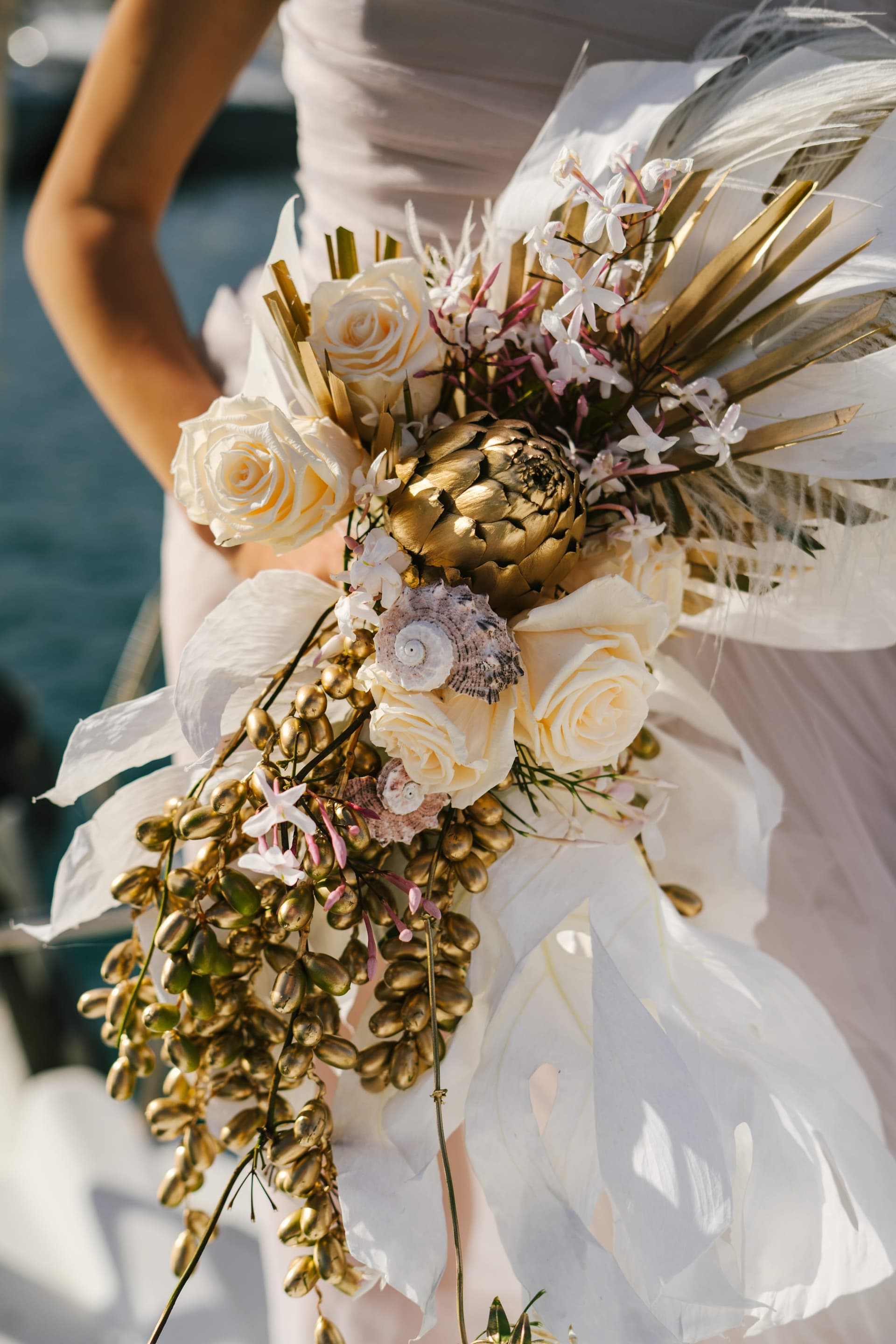
There are blossoms that refuse to fade. Dried lavender that releases its scent for months. Pampas grass that shimmers like spun gold in backlight. Lagurus, whose velvety heads feel like a whisper. Dried flowers at a wedding – this is no compromise, but a conscious aesthetic choice for timelessness.
In the context of a sustainable wedding, dried flowers play a special role: they need no water, no floral foam, no refrigerated transport. Once dried and lovingly cared for, they last for years. On the wedding day itself, they produce zero waste. And they combine beautifully with fresh flowers: a bridal bouquet of seasonal peonies with dried lavender stems and pampas grass unites the best of both worlds.
We see dried flowers not as a substitute for fresh flowers, but as their own aesthetic language. Warm, earthy tones. Vintage-like textures. A feel reminiscent of past summer afternoons. As bouquet inserts, table decorations, or lasting keepsakes for the shared home – dried flowers are as versatile as they are sustainable.
A detailed guide to dried flowers as a standalone trend with all the varieties, care tips, and decor ideas can be found in our separate article – here we focus on their place within the overall concept of sustainable wedding floristry.
Sustainable Wedding Floristry on Mallorca – Mediterranean treasures at your doorstep
Mallorca holds a secret only a few know: the island is a paradise for sustainable wedding floristry. While some flowers must be elaborately imported in Germany, on Mallorca Mediterranean plants grow in an abundance and variety that makes any florist's heart beat faster – often literally in the garden next door.
The short distances are a decisive advantage. When we design for a wedding on Mallorca, we work with local nurseries and producers we have known personally for years. The flowers don't travel thousands of kilometers – they come from the field around the corner.
Mediterranean Wedding Flowers and Their Seasons
Lavender (June – August): No fragrance on Mallorca is more iconic. Lavender fields in the island's interior produce blossoms in deep violet, perfect for table arrangements, chair sashes, and as a scented element in the bridal bouquet. Those who marry on Mallorca in high summer get lavender in an intensity that's hard to find on the mainland.
Rosemary (year-round): More than a kitchen herb. In flower symbolism, rosemary stands for fidelity and remembrance – beautiful symbolism for the wedding day. As a filler element in arrangements, it brings structure, fragrance, and deep green. And it grows everywhere on Mallorca.
Eucalyptus (year-round): The all-rounder among greenery. Eucalyptus lasts longer than any other foliage, has a subtle fresh fragrance, and lends every arrangement an elegant, casual note. On Mallorca it grows in various varieties – from delicate round-leaved types to large silver-dollar leaves. If you're interested in the botanical particularities of Mediterranean plants, the Royal Horticultural Society offers in-depth information.
Bougainvillea (May – October): Rich fuchsia-magenta that makes every finca wall glow. Bougainvillea is the ultimate mood-setter, and on Mallorca it's available in such abundance that it becomes a natural part of wedding decor.
Orange Blossom and Citrus Blossoms (April – May): The most intense and sweetest fragrance of the island. Orange blossoms in a bridal bouquet – it's a sensory experience you'll hardly find outside the Mediterranean.
Almond Blossom (January – February): Mallorca's herald of spring. Those who dare to marry on the island in winter are rewarded with a sea of blossoms that bathes the landscape in soft pink. It doesn't get more poetic.
For comparison: a wedding in Berlin in June with imported overseas roses versus a Mallorca wedding in June with lavender, bougainvillea, and rosemary from the finca next door – the more sustainable and at the same time more sensorially rich option is obvious. In our Berlin studio we work with regional sources too, but Mallorca's Mediterranean climate offers a natural sustainability advantage.
Are you planning your wedding on Mallorca and want the best of the island woven into your floral concept? Tell us about your vision.
After the Wedding – when blossoms live on
Sustainability doesn't end with the last dance. One of the most beautiful questions we ask our couples: what should happen to the flowers after the celebration? Because if you've avoided floral foam and worked with natural materials, wonderful possibilities open up – completing the cycle of a true zero-waste wedding.
Sustainable wedding favors with meaning: The table arrangements and smaller pieces don't have to end up in the trash. Prepare small vases or paper bags and invite your guests to take a piece of the wedding floristry home. Sustainable wedding favors made of real flowers that carry a piece of your day onward – it's a gift with heart and without any waste. For those who want to enjoy sustainable flowers regularly in everyday life, a flower subscription is also a wonderful idea.
Pressing blossoms: A particularly poetic ritual. Take some blossoms from your bridal bouquet, press them between heavy paper, and frame them later. A fleeting blossom becomes a piece of art that reminds you of this moment every day. Some of our brides even turn them into jewelry or stationery.
Drying the bridal bouquet: Hang your bridal bouquet upside down in a dry, dark place and let time do its work. After a few weeks, you'll hold a dried arrangement in your hands that lives on as decoration in your shared home.
Donating to hospitals or senior care homes: Flowers still fresh after the celebration can carry incredible joy onward. Some wedding venues organize the pickup – or you can plan it yourself as a final, loving act of the day.
Composting: If you've consistently avoided floral foam and worked exclusively with natural materials, all flower remnants can be composted. The cycle closes – from earth back to earth.
Upcycling: Dried petals become fragrant potpourri, elements of a seasonal door wreath, or natural confetti for the next celebration in your circle of friends.
We always advise our couples on what should happen to the flowers after the celebration. It is part of the concept – and it makes the wedding more rounded, more honest, and more beautiful.
Sustainable Wedding Floristry is the most beautiful choice you can make
A sustainable wedding is not a restriction. It is a decision for more – more fragrance, more vitality, more honesty. Seasonal flowers that bloom precisely in their moment. Materials that don't burden nature. Arrangements that get a second life after the celebration.
Sustainability in floristry means choosing every blossom with care – and that's exactly what we do. Whether in our Berlin studio or on a Mallorcan finca, whether peonies in May or almond blossoms in January: we create floristry that tells your story while leaving the earth a little better.
The most beautiful moment is when you know: every blossom in your hand had a journey – from the earth, through loving hands, to you. That is luxury. That is sustainability. That is sustainable wedding floristry.
Frequently Asked Questions
What is sustainable wedding floristry?
Sustainable wedding floristry means consciously working with natural resources: using local and seasonal flowers, avoiding conventional floral foam, working with compostable or reusable materials, and creating a cycle for the flowers after the celebration – through donations, drying, or composting. It's a holistic concept that combines aesthetics with responsibility.
What can I use instead of floral foam at a wedding?
Absolutely! There are now excellent alternatives. Kenzan (pin frog) works for shallow bowls and minimalist arrangements, chicken wire for large vases and ceremony arches, moss for natural compositions, and bio-floral foam made from basalt powder for classic builds. For bridal bouquets, stem tape and traditional binding techniques are sufficient.
Which seasonal flowers are best for a spring wedding?
Spring is a dream season for wedding flowers! Peonies unfold their full, intoxicatingly beautiful blossoms in May. Ranunculus enchant with their delicate, multi-layered petals. Cherry blossoms bring poetic lightness, tulips fresh elegance, and lilac an incomparable fragrance. In Mallorca, orange blossoms bloom in spring with a sweet, intense aroma.
Which seasonal flowers are best for a summer wedding?
In summer, local garden roses, lavender, and cosmos transform any wedding into a fragrant celebration. Mallorca adds bougainvillea in vibrant magenta, oleander in soft pink, and citrus blossoms. The summer palette ranges from soft pastels to rich, saturated tones – perfect for opulent, natural arrangements.
Why is floral foam bad for the environment?
Conventional floral foam (Oasis) is made from phenolic resin and releases microplastic particles with every use – as research by environmental scientist Dr. Trestrail has shown. The particles enter waterways and cannot be filtered out. Additionally, floral foam is neither compostable nor recyclable. The amounts add up quickly across a wedding with many arrangements.
Can I get sustainable wedding floristry on Mallorca?
Of course! Mallorca is practically made for sustainable floristry. The island has rich Mediterranean vegetation – lavender, rosemary, eucalyptus, bougainvillea, oleander, and orange blossoms grow locally and in abundance. Distances from nursery to venue are short, and we work with local producers we have known personally for years.
What happens to wedding flowers after the celebration?
There are so many beautiful possibilities! You can pass on table arrangements as sustainable wedding favors, press blossoms from the bridal bouquet and frame them, dry the entire bouquet, or donate fresh flowers to hospitals and senior care homes. If only natural materials were used, composting is also an option. The cycle closes.
Are dried flowers really sustainable for a wedding?
Absolutely! Dried flowers are one of the most sustainable options in wedding floristry. They need no water, no floral foam, and no refrigerated transport. They produce zero waste on the wedding day and continue to live as home decor afterwards. Combined with fresh seasonal flowers, they create arrangements that bring together the best of both worlds.
What is a kenzan and how is it used in floristry?
A kenzan – also called a pin frog – is a Japanese tool consisting of a heavy metal plate with fine pins. In floristry, it is placed in shallow bowls or vessels, and individual flower stems are pressed onto the pins. It provides precise support, is reusable, and lasts for decades with proper care. We use it daily in our studio – especially for minimalist and zen-inspired arrangements.
Can I combine sustainable floristry with a luxury concept?
Absolutely yes! In our daily work, we experience that sustainable floristry and luxury don't just coexist – they amplify each other. Seasonal flowers are fresher, more fragrant, and more vibrant than imported mass-market varieties. Natural materials like moss and kenzan create an organic elegance that plastic floral foam could never achieve. Designing sustainably means curating more consciously – and that is the very essence of luxury.
Sustainable WeddingSustainable Wedding FloristryFloral Foam AlternativeDried Flowers WeddingSeasonal FlowersKenzanWedding Flowers